


My first day on the job was a little intense.
Right off the bat, my new boss called me into his office.
As soon as I sat down, he dove straight into explaining things, and I was trying to absorb every word.
Then, mid-sentence, he suddenly got up, walked behind me, grabbed a pen and started writing on the whiteboard.
I stayed quiet.
He wrote three words: “Good,” “Cheap,” and “Fast.”
He circled them and said:
“You can’t have all three. If you want something done well and quickly, it’s going to be expensive. If you want it done well and affordably, it’s going to take time. And if you want it fast and cheap, well, don’t expect perfection.”
He looked me dead in the eye and added:
“This is how I want you to approach every project. You always have to choose two. Try for all three, and one will suffer.”
That simple lesson changed the way I thought about my work and shaped how I handled projects, tasks, and campaigns from that day forward.
The circle you can’t escape
Every project comes with a trade-off. There’s no way around it.
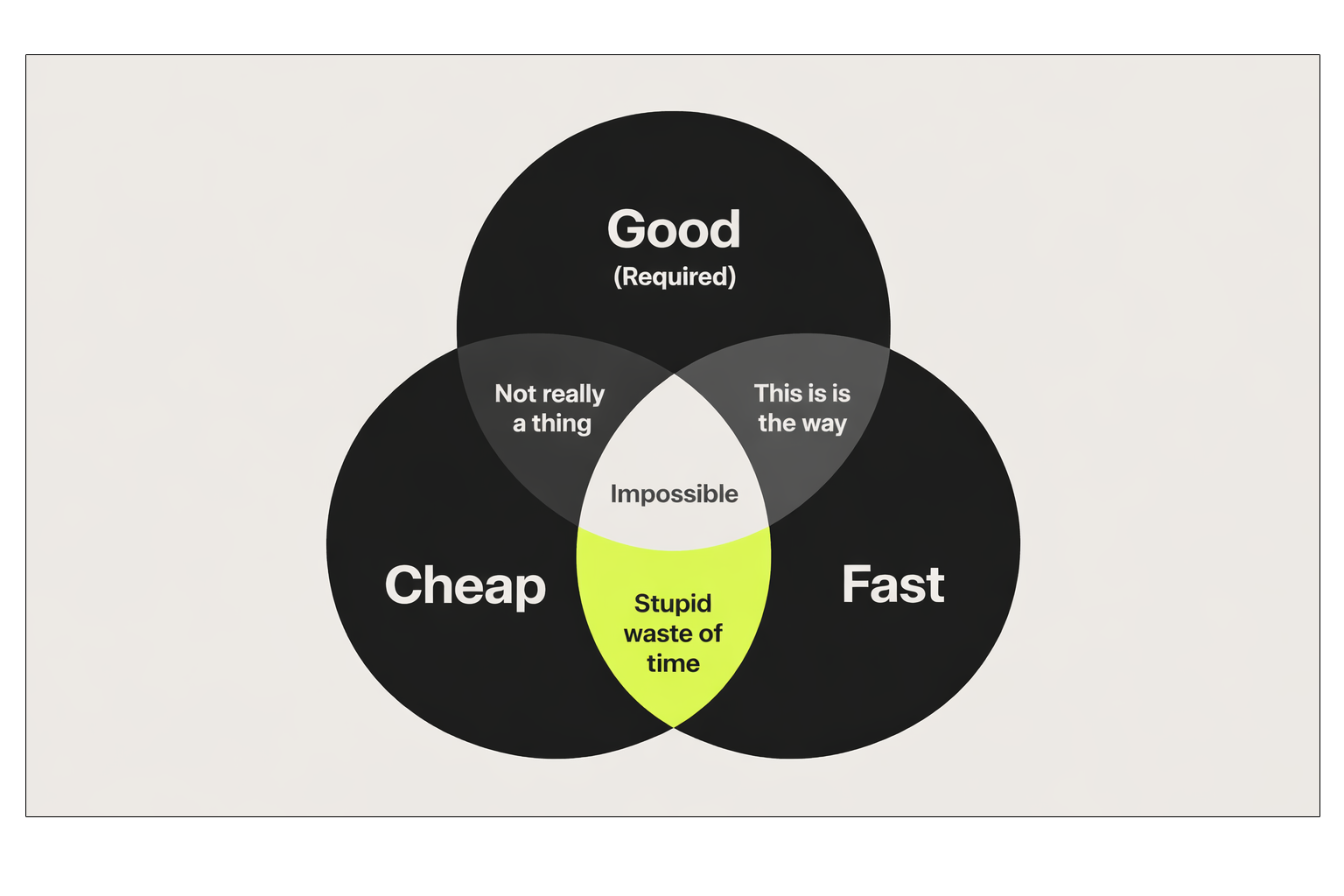
Here’s how the overlaps work:
Good + Cheap = Slow: You’ll get quality work at a low cost, but it will take time.
Good + Fast = Expensive: Want something done well and quickly? It’s going to cost you—either in money or resources.
Cheap + Fast = Low Quality: You’ll get it done quickly without spending much, but don’t expect it to be great.
All three = Impossible: The center? That’s where everyone wants to be. But it doesn’t exist.
When the boss or customer asks you to do something, you’ll be tempted to aim for all three. But it rarely works out that way.
You end up having to ask for more money, more time, or a change in scope.
How this applies to everything you do
Once you understand this, you can approach every project with clarity.
Want to work faster?
Be clear about what you want from the start. Avoid changing plans mid-project—that slows everything down. Know your hard deadlines, and if needed, move them earlier.
Think in terms of minimum viable product (MVP). Identify what’s non-negotiable and be ruthless about cutting the rest.
If you must fail, fail fast. Small, early mistakes are easier to fix than big, late ones.
Need to keep costs low?
Plan ahead. Schedule with as much lead time as possible to allow for flexibility. If things go wrong or need adjustments, having that buffer will save you from costly last-minute fixes.
You can also lock in longer-term deals for better pricing.
Want better quality?
Clarify why you’re doing the project in the first place. Break it down from there. Small uncertainties at the start can lead to major issues later on.
Don’t hesitate to ask for advice. Experts can often show you easier or better ways to achieve your goals.
Lean on your boss, mentors, or colleagues for insights on improving quality.
The choice is yours
Good, cheap, or fast…which do you choose?
You can have two, but not all three.
The moment you accept this, projects become easier. You stop chasing the impossible and start making smarter trade-offs.