


The people who move fastest in the next few years won’t be specialists. They’ll be the ones who refuse to stay in their lane.
The market doesn’t reward depth anymore. It rewards range.
Deep expertise in one narrow thing? AI can do 80% of it already. And it’s getting better every month.
But understanding how everything connects? Seeing the whole picture?
Moving fast without waiting for six different people to approve something?
That’s what separates you.
There’s a story that explains this better than anything I could say.
Dr. Dre didn’t become a billionaire by being the best rapper
He became a billionaire by refusing to stay in his lane.
Watch ‘The Defiant Ones’ on Netflix. But the most important scene isn’t the big sale.
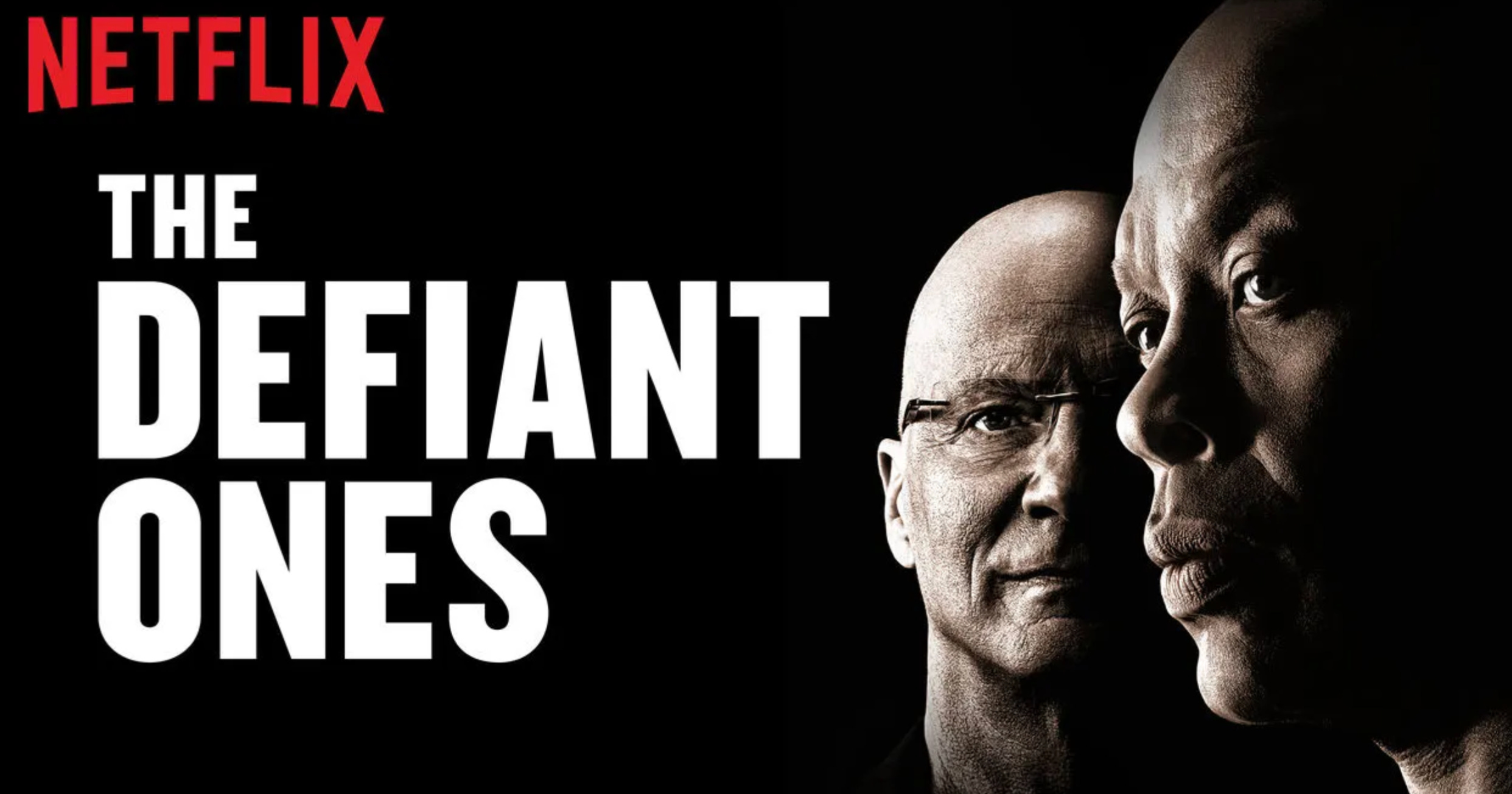
It’s the first time Dre walked into Jimmy’s office with a CD.
Jimmy Iovine was already a legend in the music industry. He’d started by sweeping floors in recording studios, then became an assistant, then an audio engineer, then a producer working with the biggest artists in the world. He knew what great work sounded like.
When he heard Dre’s CD, he couldn’t believe it.
“This is incredible. Who mixed this? Who produced it?”
Dre: “I did.”
Jimmy pushed further.
“Wait, you wrote the lyrics? Created all the sounds? Produced the entire thing? Did the artwork? Packaged it for sale? Even figured out the marketing angles?”
“Yeah.”
That’s when Jimmy knew he had to work with him.
Because Dr. Dre wasn’t just a rapper. He wasn’t just a producer. He understood the entire process from creation to customer.
He was what we call full stack.
Why this story changed everything
That scene with Dr. Dre and Jimmy Iovine fundamentally shaped how I approach marketing and business.
Because I realized: I’m naturally like this.
I always seek to understand the whole business, not just my piece of it. The big picture. The details. How everything interconnects.
Throughout my years in growth marketing, I’ve asked “why?” so many times people probably wanted to kill me.
Why does this campaign work but that one doesn’t?
Why does finance calculate ROI that way?
Why does the product team prioritize features like this?
Why do customers churn after 90 days?
Why does support get these specific questions?
There’s actually a formal problem-solving technique called “The 5 Whys.”
You ask “why” five times to get to the root cause of any problem. I basically did this with everything in the business until I understood how it all connected.
And here’s what I learned: That curiosity is what made me valuable.
Not because I was the absolute best at any one thing.
But because I could see how everything fit together, spot bottlenecks before they happened, and move fast without waiting for six different people to approve something.
When you understand the full stack, you don’t get stuck.
You don’t say “that’s not my job.” You just figure it out and keep moving.
The pattern is everywhere
Once you see it, you can’t unsee it.
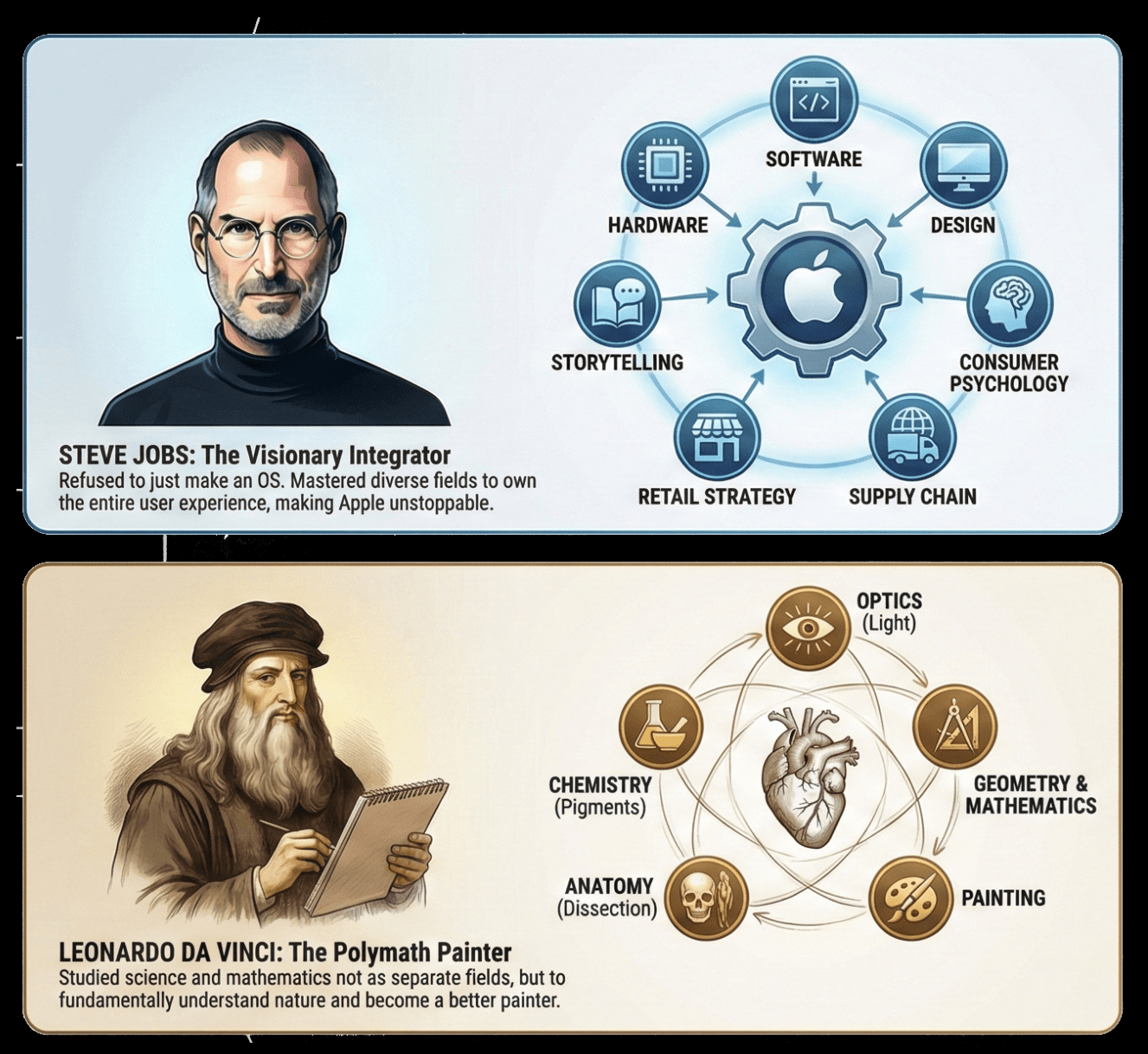
Steve Jobs didn’t just understand software. He mastered hardware, design, consumer psychology, supply chain, retail strategy, and storytelling. Not the best at any single thing, but the combination made Apple unstoppable. He refused to make just an operating system and let someone else build the computer. He wanted to own the entire experience.
Leonardo da Vinci studied chemistry to mix better pigments. Learned optics to understand light. Studied geometry, mathematics, and dissected human bodies to understand anatomy, all to become a better painter.
Michael Jordan didn’t specialize like most NBA players (defense, three-pointers, or scoring). He mastered all three at an elite level. That’s what separated him from everyone else.
Michael Jackson wrote his own lyrics, created songs and sounds, choreographed his own dances, designed costumes, controlled the lighting, and produced everything. He owned the entire experience from creation to stage.
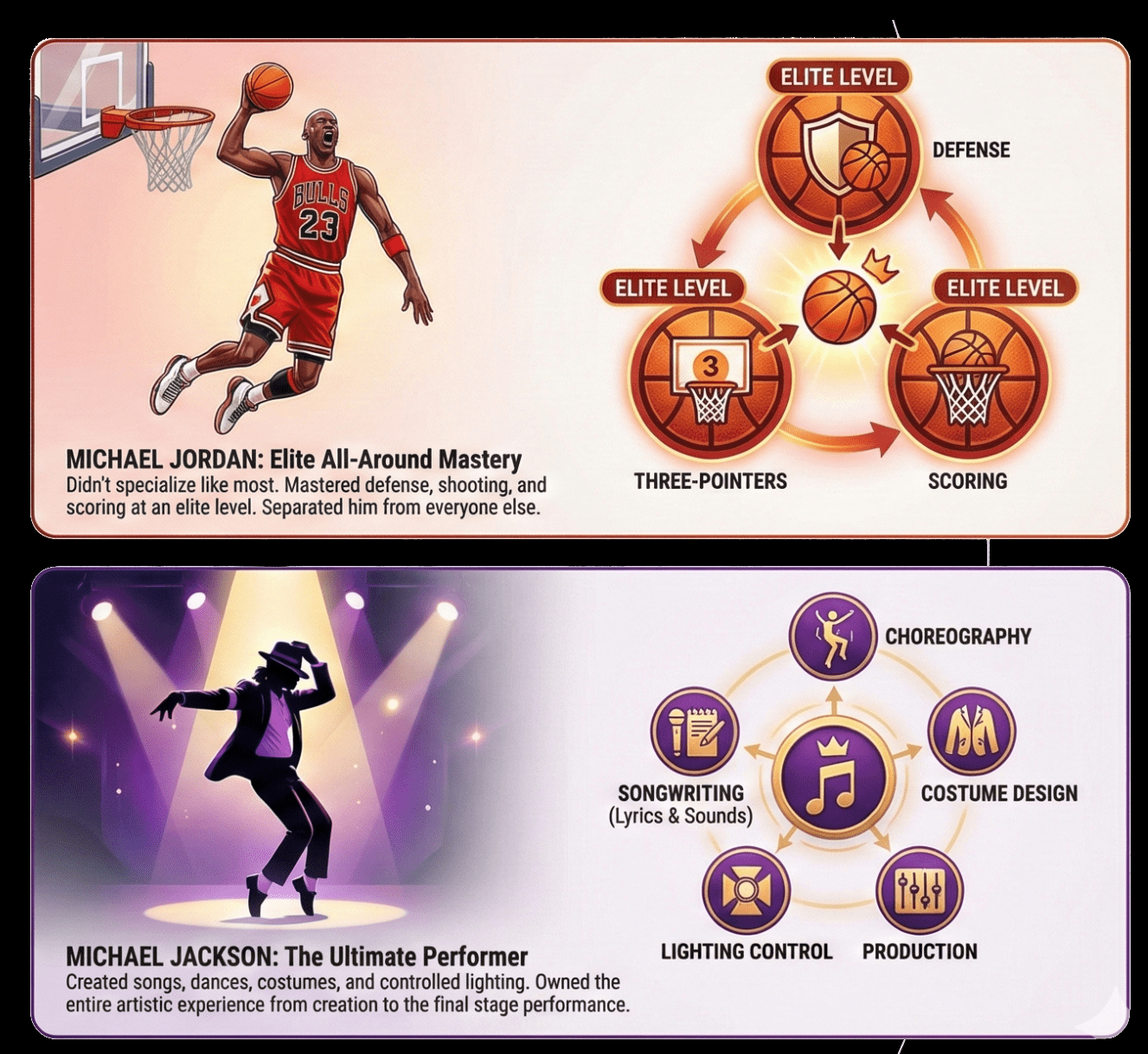
The pattern is clear: The people who win don’t just go deep in one area. They build expertise on top of broad foundations.
What full-stack actually means
Being full-stack doesn’t mean being mediocre at everything.
Think of it like a T:
The horizontal bar: Broad competence across many domains. You understand how businesses make money, customer psychology, copywriting, design fundamentals, how funnels convert, basic finance, what good data looks like.
The vertical bar: Deep expertise in 1-2 areas where you’re genuinely excellent.
You spend 80% of your time in your zone of genius. But that other 20%, instead of stopping and saying “not my job,” you just handle it.
This is what Google calls “T-shaped people.” Deep and narrow in your specialty, wide and informed everywhere else.
What it could look like for marketing
The fundamentals haven’t changed, but the essential skills have evolved dramatically. Here’s what matters now:
1. Practical AI Fluency
You need to:
Spot the broken workflows in your marketing process where AI could actually help
Build prompts that handle real work, not just polish your copy
Show your team how to use these tools without needing you every time
Filter signal from noise as new capabilities emerge weekly
The pattern: Identify the problem. Deploy AI to fix it. Train others to do the same.
2. Tech Stack Fluency
You’re not a developer. But you can’t be helpless around technology either.
You need to:
Map out which marketing tools exist and how they talk to each other
Assess new platforms quickly
Collaborate with technical teams without needing a translator
Grasp enough about how data moves through systems to be dangerous
3. Experimental Mindset
This is about velocity and judgment combined. You need to:
Launch rapid tests of unconventional ideas
Distinguish meaningful signals from random fluctuations
Move winners to scale immediately
Balance what the data shows with what your instincts tell you
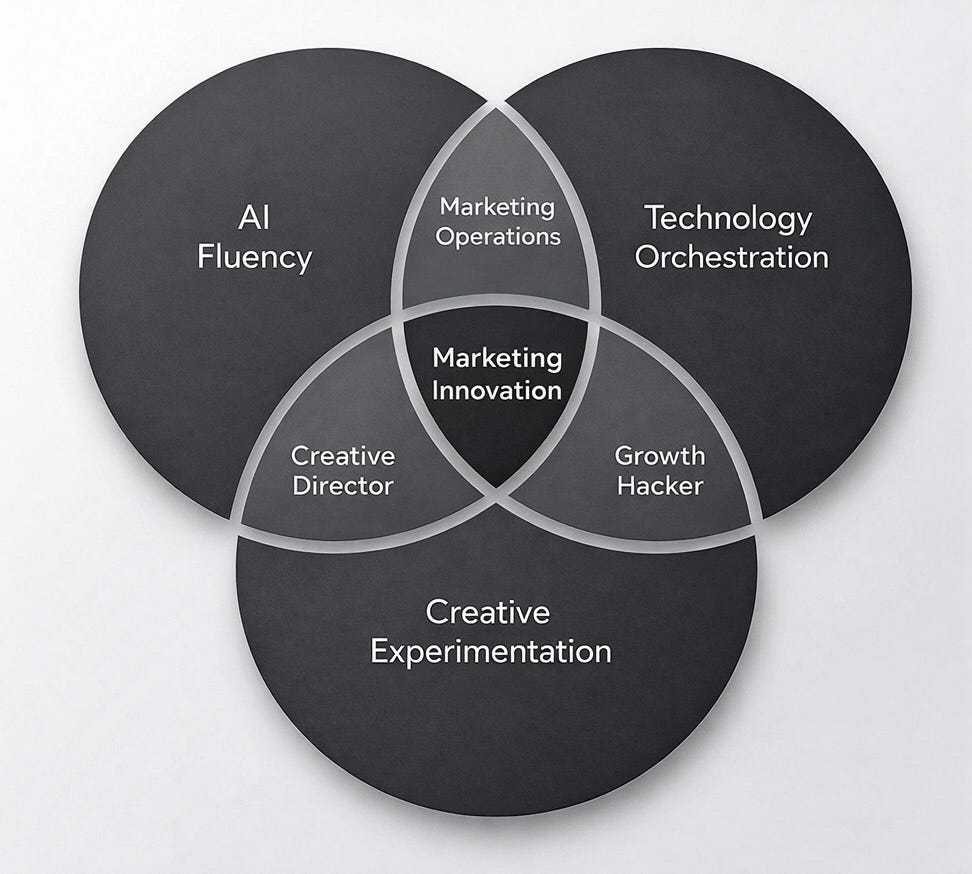
The Foundation (Still Critical)
You still need the basics:
Customer psychology (understanding why people buy and what messaging resonates)
Business fundamentals (how companies make money, P&L basics, CAC vs LTV)
Copywriting (selling with words, writing emails that convert)
Design thinking (what makes images and pages convert)
Data literacy (reading analytics, knowing what metrics matter)
Marketing mechanics (funnels, conversion rates, attribution modeling)
Finance basics (the difference between cash and revenue, contribution margin, payback periods)
Platform knowledge (how social algorithms work, what drives distribution)
Why AI makes this more important, not less
AI is making specialists less valuable and full-stack people more valuable.
If you only know how to do one narrow thing, AI can probably do 80% of it already and it’s getting better every month.
But if you understand how everything connects, you can use AI as a force multiplier to move 10x faster than before.
The full-stack marketer who understands psychology, copywriting, design, data, and strategy can now use AI to:
Generate 50 headline variations in seconds (then pick the best ones using their judgment)
Analyze campaign data and spot patterns instantly
Create visual concepts without waiting for a designer
Write and test copy faster than ever
Automate repetitive tasks and focus on strategy
They’re not being replaced by AI. They’re becoming unstoppable because of it.
The specialist who only knows how to “run Facebook ads” is in trouble. The full-stack growth marketer who understands acquisition, conversion, retention, economics, and can orchestrate AI tools? They’re worth 10x more than two years ago.
Tools change. Psychology doesn’t.
Here’s what keeps me grounded:
Focus on the psychology, not the technology.
The fundamentals of marketing, human behavior, and decision-making aren’t changing. How trust is built. How people make choices. What drives action.
These don’t become obsolete just because the tools evolve.
You can swap out any tool. But the system and foundations stay the same.
So don’t be obsessed with the tools. Treat them as a means to solve problems. Master the psychology. Understand the systems.
That’s what survives.
Final thought
Don’t be the person who says “that’s not my job.”
The market doesn’t need more specialists who can only do one thing.
It’s desperate for people who can see the whole picture and make things happen.
Be that person in 2026.
P.S. If you haven’t watched “The Defiant Ones” on Netflix, do it this week. It’s the best documentary I’ve seen on what full-stack actually looks like in practice and why it’s the difference between good and unstoppable.